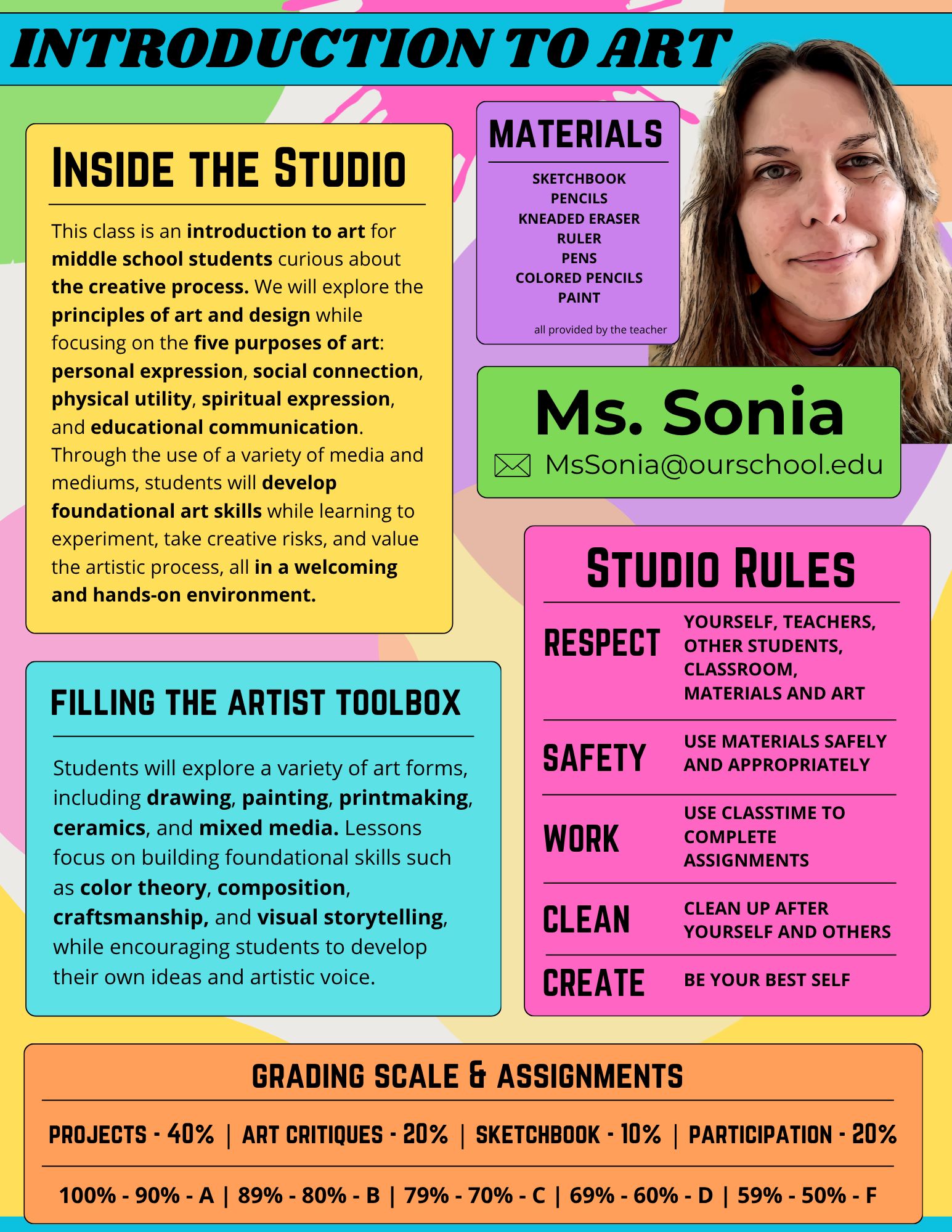
On the first day of school, I tell my students something many of them don’t expect to hear: you don’t have to be “good at art” to belong in this room. I believe every student can make art that matters, and that art class may be the one place in the school day where there is no single right answer. My job is to build a studio where students feel safe enough to take creative risks, curious enough to keep going, and skilled enough to say what they mean.
Art matters because it gives students another language. Through the five purposes of art (personal expression, social connection, physical utility, spiritual expression, and educational communication), students learn that art isn’t only decoration. It’s how people have always told their stories, solved problems, and connected with one another. I’ve also spent more than 20 years working as a graphic and web designer, so I know firsthand that art is a real skill set and a real career. I want my students to leave my class with foundational skills in color, composition, and craftsmanship, and with the confidence to use those skills to say something of their own.
In my classroom, mistakes are part of the process. I teach students to be curious first. Instead of I can’t do this, we ask, What happens if I try? I model every project through live demonstrations, visual step-by-step guides, and teacher samples, so students can follow the process in more than one way. Then I give them real choices in subject, materials, and format, so every student has a way in and a way to show what they know. Clear routines for entering the studio, gathering materials, and cleaning up give students the structure they need to take risks safely. When things go off track, the goal is always to solve the problem and get the student back into the studio, not to push them out of it.
Students learn best when they see themselves in what they study. Drawing on Dr. Sharroky Hollie’s culturally and linguistically responsive teaching, I work to validate and affirm the cultures and languages my students bring from home, and then build and bridge to the academic language and expectations of the art world. My first project of the year is a mini zine in which each student shows me who they are, how they learn best, and the languages they speak, so that I can learn how to teach them well. I choose artist exemplars that reflect my students’ cultures and communities. When we work with imagery from a living culture, we talk about the responsibility an artist has to that culture.
I know my teaching is working when I see growth in students’ sketchbooks, hear it in their critiques, and watch a student who once said “I can’t” try something new. I keep making my own art so I never forget what it feels like to start something hard. Above all, I want every student to walk into my studio curious and walk out asking, What happens if I try?